Having had such little exposure to this type of learning or subject matter, I initially thought I would struggle and may (rather ashamedly) overlook this module. This was paired with scepticism about the MOOC and the belief that blogs were a rather outdated medium. In actual fact, my experience was quite the opposite. I found the subject matter refreshing, challenging, and stimulating, and having a variety of learning styles was enriching. I have since started to blog externally, often finding myself reading the blogs of others, and am currently participating in another MOOC specialised for data science and fully expect to participate in many more in the future. Genuinely, I have never been so happy about a module proving me wrong!
The new MOOC I am participating in (left), inspired by this modules MOOC (right)
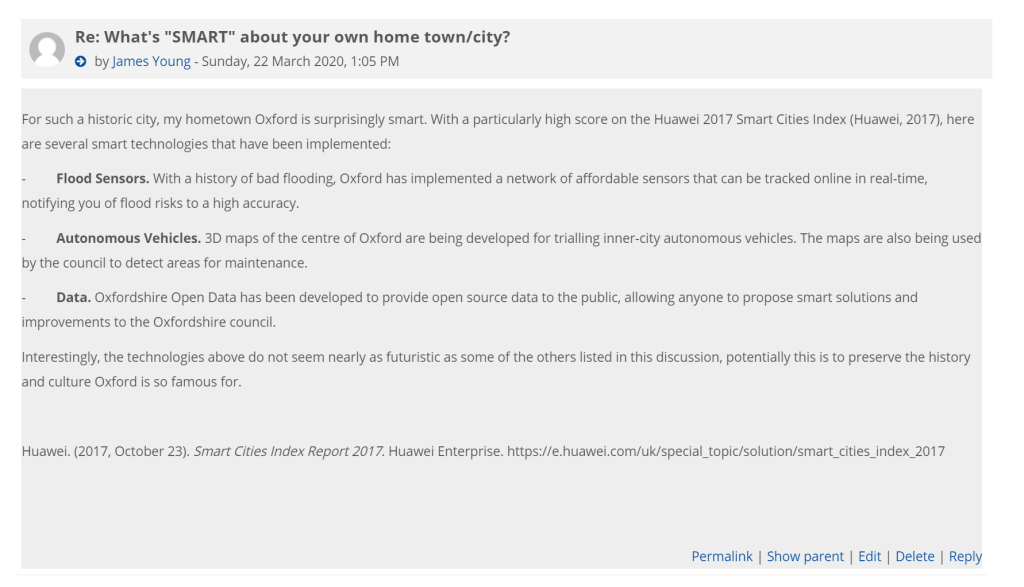
As the first business module I have ever taken, I feel as though this has given me a sturdy fundamental knowledge towards the future of businesses, as well as teaching me how to learn independently whilst navigating a sea of fake news. Within my Data Science Master’s most of my time is spent learning foundational skills rather than looking at the breadth of applications and how they can be applied. This module unexpectedly taught me a large amount regarding the areas in business this science is utilised, particularly in the discussions regarding the smart cities and SMAC technologies (as shown below). I found this course acted as the bridge connecting elements of my master’s and the real world.
My contribution to the SMAC discussion
Evidence of Smart City technologies in Oxford
Interestingly, for both the MOOC and the module discussions I would find myself prematurely thinking there was nothing of value I could add, possibly due to them being a bit out of my comfort zone initially. It was only after I pushed and challenged myself to contribute that interesting and stimulating opinions came to me. The incentive to do well became a second thought and contributing and learning from these discussions became my priority. This mentality is something I will certainly take forwards with my learning and clearly will be of great help in the workplace.
Finally, a highlight of this module. Despite being digital, I loved that this is the module I felt most connected with other students. Being digital seemed to break down subconscious social barriers, allowing for rich discussions with students from all backgrounds. Integrating this approach in wider university academia can only be beneficial.
This video expands on some of the above points, as well as presenting evidence of my learning in both the MOOC and blog comments:
With a current grocery market share of 16%, Sainsbury’s is the second most popular supermarket chain in Great Britain (Wunsch, 2020). This success has largely been down to their ability to pioneer the technology of tomorrow. Whilst many shop in a conventional brick-and-mortar fashion, Sainsbury’s has identified the importance of adopting a more future-proof digital business model. Social, mobile, analytical and cloud (SMAC) technologies are, in my opinion, the four most fundamental components to Sainsbury’s success.
(Sainsbury’s 2019)
(Glenday, 2019)
Social. Sainsbury’s use of social technologies is both creative and effective. From their comedic to instructive YouTube videos, to their incredibly responsive Twitter feed, Sainsbury’s has embraced most social media platforms. Creating a strong online presence is vital for a company, not only for managing complaints but for increasing customer interest and spending. For instance, Sainsbury’s made a profit of £24 for every £1 they spent on their 2014 Christmas advert (Rodionova, 2016).
Sainsbury’s Comedic Youtube Example (Sainsbury’s, 2015)
This social aspect is not limited to customers, however; employees are also using social digital platforms, such as Sainsbury’s own social network called Yammer, which allows staff to express concerns and feelings anonymously. This effective use of technology for staff and customers has had remarkable success, with them being deemed ‘the most socially influential UK retail brand’ in 2014 (Briggs, 2014).
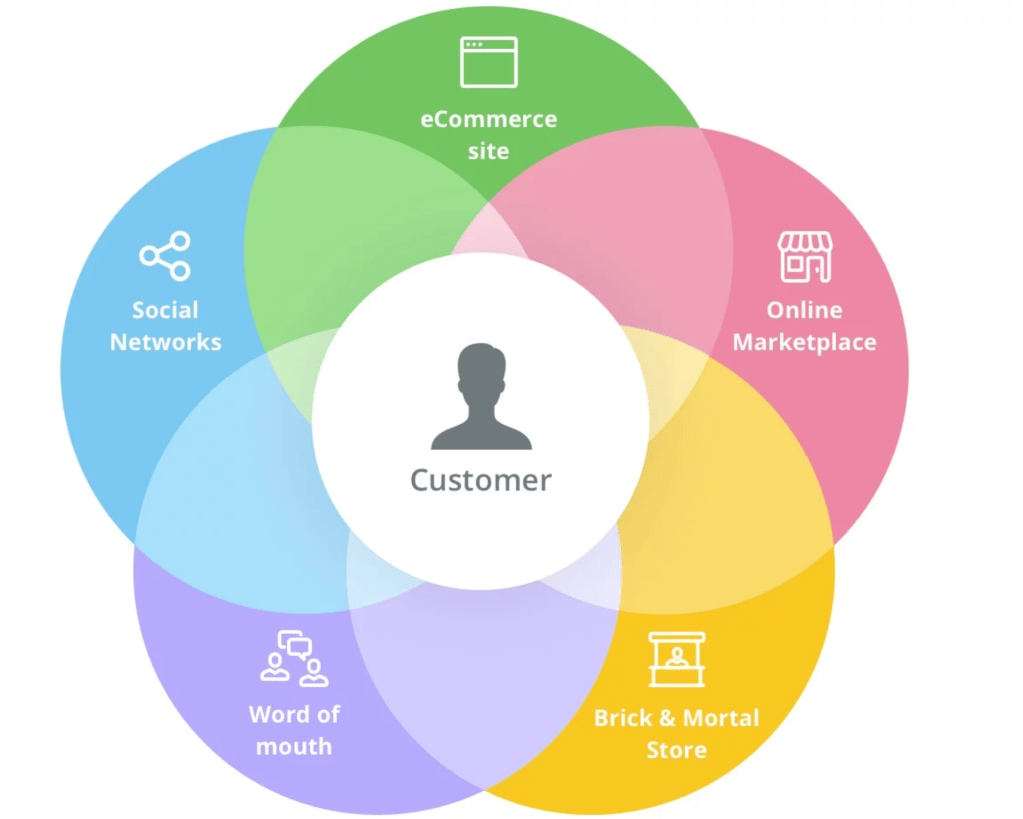
Mobile. Nowadays, having an online presence is nothing special, however, a recent unique shift in the structure of Sainsbury’s has been ambitious yet effective. Upon purchasing Argos in 2016, Sainsbury’s and Argos have made the transition to a customer-centric, omnichannel approach (SupplyChainBrain, 2017). This strategy focuses on the consumer, with all their communication channels holistically operating to deliver the most personal and engaging experience possible. With online sales increasing from £500 million in 2010 to £5 billion in 2019, this approach is clearly effective (Sainsbury’s, 2019, p. 5). In addition, the sharing of resources, such as staff and delivery networks, has been incredibly beneficial, with savings of £160 million due to synergies with Argos (Sainsbury’s, 2019, p. 81).
Omnichannel Visual (X-Cart, 2019)
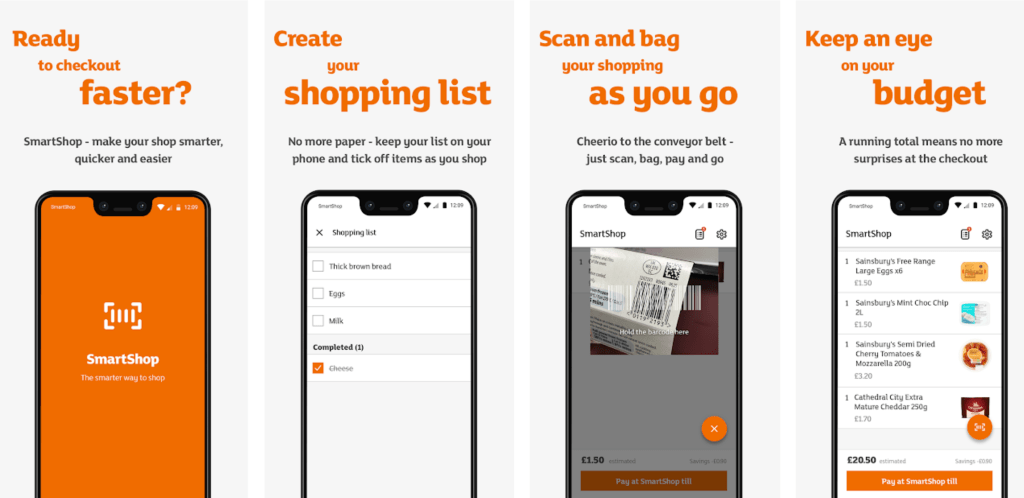
A benefit of this omnichannel strategy is the breaking down of walls between the digital marketplace and the physical marketplace. For instance, in April last year Sainsbury’s introduced the UK’s first till-free store (Glenday, 2019). This allowed customers to enter the shop, scan items using the Sainsbury’s SmartShop Scan app, and then pay from their phone as they leave. SmartShop has since been implemented in over 100 shops (Sainsbury’s, 2019, p. 9). Not only do SmartShop customers spend 18% more than regular shoppers, they also receive exclusive promotions as they shop, such as wines that complement the meal they have just scanned, or Sainsbury’s burgers to go with the Argos BBQ they just picked up (Macaulay, 2019). I believe this to be the perfect balance between efficiency and productivity, whilst still maintaining the human interaction customers are so fond of.
Key features of the SmartShop App (Sainsbury’s, 2020)
Analytical. The analytical side of Sainsbury’s is massive, with huge value being added to both the colleague and customer. The collection and analysis of millions of spending habits can provide tailored predictions and promotions for customers, increasing their brand loyalty and supporting shopper retention. Whilst this all seems very standard for a supermarket, I was shocked with its intricacy and effectiveness. Just last week, my Sainsbury’s app pinged an offer on teabags to me. It had been a month since my last in-shop purchase and Sainsbury’s (rightly) thought it was about time I restocked, gaining themselves extra sales, and me, extra tea, win-win! In addition, having recognised that those who shop both online and in-store spend 2.4 times more than those who shop purely in-store, offers and rewards are given for multiple channels, encouraging engagement with Sainsbury’s most profitable avenue (Macaulay, 2019).
When not suggesting teabags to me, this technology is used in countless other areas of the company, from informing farmers on how to grow better lettuce, to optimal product arrangements in stores. Andy Day, the chief data officer, aptly states the motivation for this: ‘In a business that turns over close to £30 billion, you only have to move some of those small levers a tiny bit to make a significant difference.’ Day is embracing the importance of data, with a goal of employing 700 data specialists for Sainsbury’s (Bennett, 2017). I believe this mindset and embracive approach has been (and will continue to be) paramount to their success.
‘In a business that turns over close to £30 billion, you only have to move some of those small levers a tiny bit to make a significant difference.’
Andy Day – Sainsbury’s cdo (Bennett, 2017)
Cloud. Cloud technology is the fundamental enabler for the previous three technologies. It allows companies to collect, store, and interpret vast sums of data, without requiring the in-house infrastructure to do so. In 2019 Sainsbury’s announced their utilisation of Google Cloud, allowing for their social genius, omnichannel excellence, and analytical effectiveness to thrive (Coad, 2019). Without the cloud, a company’s digital business model would struggle. However, the difference between a well-optimised cloud system and a flawed one is where the success of Sainsbury’s lies.
Enhancing these four technologies has been revolutionary for shaping and moulding the digital business model that has allowed Sainsbury’s to thrive and will likely continue to pave the way for their future success.
From automation to circulation, the evolution of the digital economy has disrupted and transformed the role of news journalists.
News journalists produce topical articles for newspapers, magazines and the internet. The digital economy is very aptly summed up by Deloitte as, ‘the economic activity that results from billions of everyday online connections among people, businesses, devices, data, and processes.’ (Deloitte, n.d., para. 3). How does this impact journalists though, and how can this be expected to change into the future?
(Качаев, n.d.-c)
Gone are the days where you pop down to the newsagents and purchase a paper covering the news from two days ago. Now, you open your computer and within 2 clicks you have access to a continually growing, live news source. This effortless public distribution of content has caused huge competition for the once few beacons of journalism. Whilst good for the consumer, certain industries such as the printing press have taken a hit. For instance, The Sun’s daily December sales have decreased from 3 million in 2010 to 1.2 million in 2019 (Jones, 2020). Radio journalism has also been impacted; upon interviewing multiple award-winning radio producer Adam Fowler, he mentioned to me that, “all the money is now in non-linear platforms, Radio 4 is doing a big push to attract ‘replenishers’ [under 35s] as they have a much more digital profile” (A. Fowler, personal communication, 6 February 2020). Whilst I agree with him that non-linear platforms are popular, I wouldn’t necessarily say this is bad, as this transition has opened new avenues for work, and has provided a more contemporary, streamlined news experience for many.
“all the money is now in non-linear platforms”
Adam Fowler
One of the biggest changes the digital economy has had on news journalism is the shifting sources of revenue, with profits becoming increasingly unpredictable. Physical papers generated most of their income through consistent sales with relatively predictable numbers. Transitioning online has allowed for the extreme utilisation of targeted adverts, undeniably their main source of revenue. This is not without its flaws; simple ad-blockers have vast economic impacts with them causing an estimated loss of $15.8 billion for US publishers in 2016 alone (Sullivan, 2017, para. 2). Why is this acceptable, yet stealing a paper isn’t? Despite the struggle, many journalists accept that online is the future, with companies hiring specialists to detect the blockers or even resort to offering extra content with subscriptions.
(Качаев, n.d.-b)
(Качаев, n.d.-a)
(Качаев, n.d.-d)
In the past, journalists relied on a network of people. Now, many rely on a network of algorithms. The era of sending out journalists to interview and collect possible leads is no more. With the new age wave of machine learning and artificial intelligence, rather than having to search for ideas, journalists nowadays resort to technology. This has caused a serious shift in recruitment, with technology specialists being relied upon. Computers can analyse thousands of sites, millions of potential events, and billions of social media interactions, and within seconds predict what the next best article is. This previously fundamental component of the job could soon cease to exist.
Unfortunately, however, there is some bleakness on the horizon. Developing new skills is becoming increasingly important for journalists to mitigate the propagation of one of the biggest threats to their reputation. Fake news. From the echo-chambers of social media to malicious machine-learning, the future of dependable journalism lies in their separation from the bias and counterfeits. A particularly effective way for the consumer to detect this is the AI Chrome extension FakerFact developed by Mike Tamir. This analyses an article and reports back on its validity (Tamir, 2018). Deep fakes have been particularly detrimental. Essentially, these are hyper-realistic photoshopped videos, produced in a fraction of a second, yet can ruin careers for both the video’s subject and the journalists who falsely trusted the ‘evidence’. Whilst training specialists in this niche area might sound counterintuitive, AI is not just the cause but the solution. Producing algorithms to detect the validity of visuals is going to be essential for journalists, as seeing is no longer believing.
(Young, 2020)
(Webtunix, n.d.)
(BuzzFeedVideo, 2018)
Whilst most news sites predict articles for you to read, the rise of AI-based sites could be the fall of the traditional news journalist. Apps such as Toutiao monitor your behaviour – from previously read articles, to the current location, to the time between screen taps – and automatically compiles a tailored news feed. This app is popular. Like, really popular. Over 200 million daily users in China spend an average of 76 minutes on this app. Over 1.1 million journalists, social influencers and AI bots contribute content daily (DIGIPANDA, 2018, para. 2). This has taken China by storm, with news firms taking a big hit. Check out 2 minutes into the video on the right to really see the scale of this company.
(DIGIPANDA, 2018)
What is Toutiao? Who is Bytedance? Discover the most popular Chinese content company. (Belleghem, 2019)
The rapid evolution of the digital economy is so volatile that the future of this industry is hard to predict. Many believe journalism is reliant on the interpretation and communication that only humans can provide, yet others think that soon humans will be merely assisting the technology, and that the machines will overtake. I tend to take a more optimistic approach. I believe that human and machine can coexist mutualistically in this industry, harmoniously operating to create a future of journalism that is dynamic, creative and an improvement for all.
(Качаев, n.d.-e)
References:
Belleghem, S. (2019, January 15). What is Toutiao? Who is Bytedance? Discover the most popular Chinese content company. [Video file]. https://www.youtube.com/watch?v=ZqNu48NEL90
My name is James Young and currently I am studying an MSc in Data Science (apologies in advance for grammatical errors – I am more used to writing code than words!). My education at Exeter began with a BSc Mathematics degree which I graduated from last summer, before promptly deciding to stay in education (or more aptly, stay out of work) which led to this master’s.
Outside of data science, I have a large involvement in music at the university, including running the university’s brass ensemble and playing the trumpet in operas. As well as this, I am also a residence life mentor for 94 first years at the university, involving weekly visits and organising trips and events for them around the UK.
This module was of particular interest to me due to how different it is from anything I have previously studied at university. I hope to push myself out of my comfort zone whilst learning how the skills and techniques I have developed in data science apply to the businesses around us.