From automation to circulation, the evolution of the digital economy has disrupted and transformed the role of news journalists.
News journalists produce topical articles for newspapers, magazines and the internet. The digital economy is very aptly summed up by Deloitte as, ‘the economic activity that results from billions of everyday online connections among people, businesses, devices, data, and processes.’ (Deloitte, n.d., para. 3). How does this impact journalists though, and how can this be expected to change into the future?

Gone are the days where you pop down to the newsagents and purchase a paper covering the news from two days ago. Now, you open your computer and within 2 clicks you have access to a continually growing, live news source. This effortless public distribution of content has caused huge competition for the once few beacons of journalism. Whilst good for the consumer, certain industries such as the printing press have taken a hit. For instance, The Sun’s daily December sales have decreased from 3 million in 2010 to 1.2 million in 2019 (Jones, 2020). Radio journalism has also been impacted; upon interviewing multiple award-winning radio producer Adam Fowler, he mentioned to me that, “all the money is now in non-linear platforms, Radio 4 is doing a big push to attract ‘replenishers’ [under 35s] as they have a much more digital profile” (A. Fowler, personal communication, 6 February 2020). Whilst I agree with him that non-linear platforms are popular, I wouldn’t necessarily say this is bad, as this transition has opened new avenues for work, and has provided a more contemporary, streamlined news experience for many.
“all the money is now in non-linear platforms”
Adam Fowler
One of the biggest changes the digital economy has had on news journalism is the shifting sources of revenue, with profits becoming increasingly unpredictable. Physical papers generated most of their income through consistent sales with relatively predictable numbers. Transitioning online has allowed for the extreme utilisation of targeted adverts, undeniably their main source of revenue. This is not without its flaws; simple ad-blockers have vast economic impacts with them causing an estimated loss of $15.8 billion for US publishers in 2016 alone (Sullivan, 2017, para. 2). Why is this acceptable, yet stealing a paper isn’t? Despite the struggle, many journalists accept that online is the future, with companies hiring specialists to detect the blockers or even resort to offering extra content with subscriptions.

(Качаев, n.d.-b) 
(Качаев, n.d.-a) 
(Качаев, n.d.-d)
In the past, journalists relied on a network of people. Now, many rely on a network of algorithms. The era of sending out journalists to interview and collect possible leads is no more. With the new age wave of machine learning and artificial intelligence, rather than having to search for ideas, journalists nowadays resort to technology. This has caused a serious shift in recruitment, with technology specialists being relied upon. Computers can analyse thousands of sites, millions of potential events, and billions of social media interactions, and within seconds predict what the next best article is. This previously fundamental component of the job could soon cease to exist.
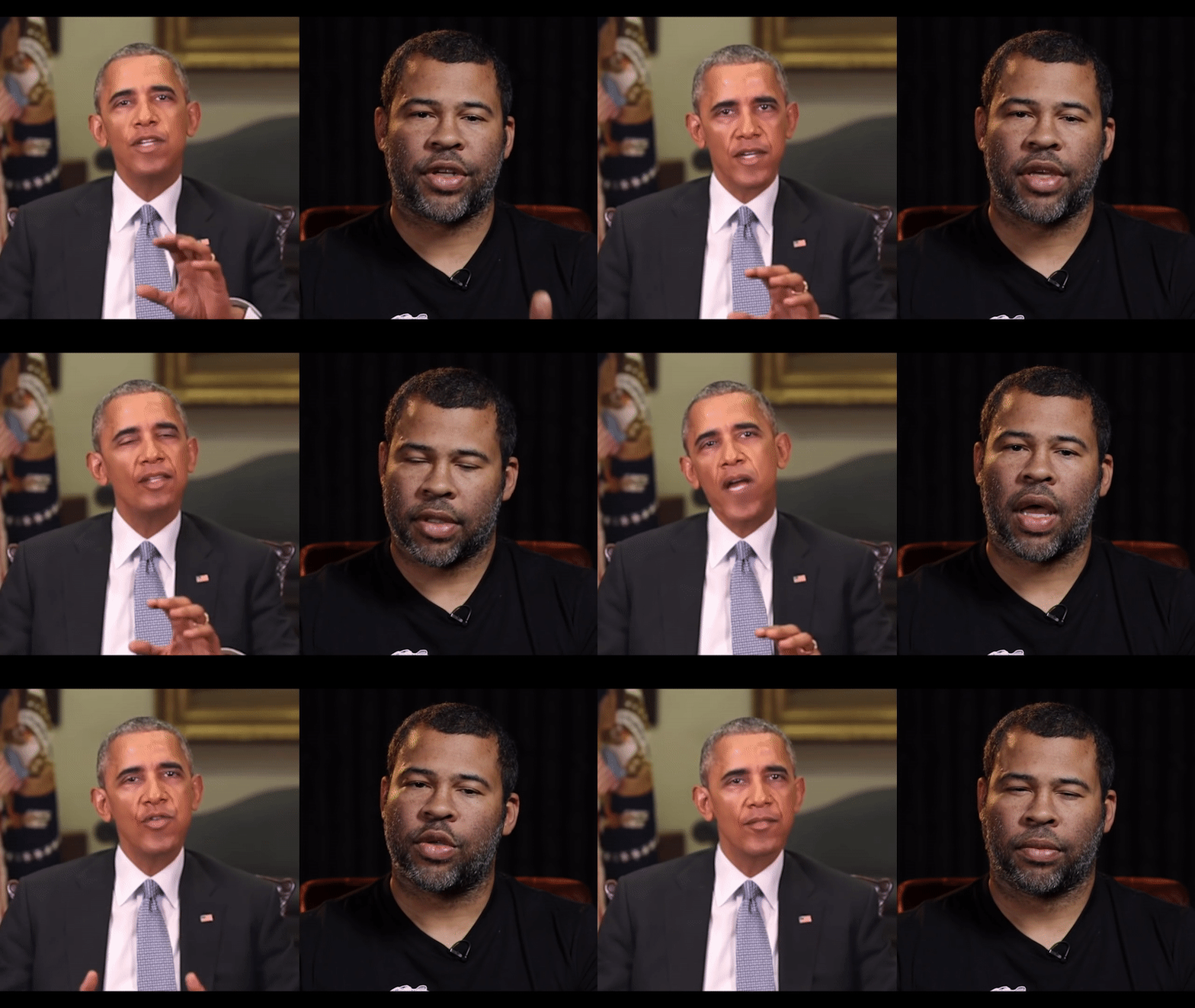
Unfortunately, however, there is some bleakness on the horizon. Developing new skills is becoming increasingly important for journalists to mitigate the propagation of one of the biggest threats to their reputation. Fake news. From the echo-chambers of social media to malicious machine-learning, the future of dependable journalism lies in their separation from the bias and counterfeits. A particularly effective way for the consumer to detect this is the AI Chrome extension FakerFact developed by Mike Tamir. This analyses an article and reports back on its validity (Tamir, 2018). Deep fakes have been particularly detrimental. Essentially, these are hyper-realistic photoshopped videos, produced in a fraction of a second, yet can ruin careers for both the video’s subject and the journalists who falsely trusted the ‘evidence’. Whilst training specialists in this niche area might sound counterintuitive, AI is not just the cause but the solution. Producing algorithms to detect the validity of visuals is going to be essential for journalists, as seeing is no longer believing.


Whilst most news sites predict articles for you to read, the rise of AI-based sites could be the fall of the traditional news journalist. Apps such as Toutiao monitor your behaviour – from previously read articles, to the current location, to the time between screen taps – and automatically compiles a tailored news feed. This app is popular. Like, really popular. Over 200 million daily users in China spend an average of 76 minutes on this app. Over 1.1 million journalists, social influencers and AI bots contribute content daily (DIGIPANDA, 2018, para. 2). This has taken China by storm, with news firms taking a big hit. Check out 2 minutes into the video on the right to really see the scale of this company.

(Belleghem, 2019)
The rapid evolution of the digital economy is so volatile that the future of this industry is hard to predict. Many believe journalism is reliant on the interpretation and communication that only humans can provide, yet others think that soon humans will be merely assisting the technology, and that the machines will overtake. I tend to take a more optimistic approach. I believe that human and machine can coexist mutualistically in this industry, harmoniously operating to create a future of journalism that is dynamic, creative and an improvement for all.
References:
Belleghem, S. (2019, January 15). What is Toutiao? Who is Bytedance? Discover the most popular Chinese content company. [Video file]. https://www.youtube.com/watch?v=ZqNu48NEL90
BuzzFeedVideo. (2018, April 17). You Won’t Believe What Obama Says In This Video! 😉 [Video file]. https://www.youtube.com/watch?v=cQ54GDm1eL0
Deloitte. (n.d.). What is digital economy? | Deloitte Malta | Technology. Deloitte. Retrieved 13 February 2020, from https://www2.deloitte.com/mt/en/pages/technology/articles/mt-what-is-digital-economy.html
DIGIPANDA. (2018, October 5). Toutiao: An Emerging Social Media Platform in China that You Can’t Afford to Ignore – Digipanda [Weblog]. https://www.digipanda.co.uk/toutiao-an-emerging-social-media-platform-in-china-that-you-cant-afford-to-ignore/
Fowler, A. (2020, February 6). Interview with Radio Journalist Adam Fowler [Personal communication].
Jones, T. (2020). The Sun, Brand Report. https://www.abc.org.uk/Certificates/49873322.pdf
Sullivan, L. (2017, October 16). U.S. Publishers: $15.8B Annual Revenue Lost To Ad Blocking. https://www.mediapost.com/publications/article/308814/us-publishers-158b-annual-revenue-lost-to-ad.html
Tamir, M. (2018, March 12). #13 Fake News Detection with Data Science [Podcast]. https://soundcloud.com/dataframed/13-data-science-and-fake-news
Webtunix. (n.d.). Faceman.gif. Retrieved 13 February 2020, from https://www.webtunix.ai/static/img/faceman.gif
Young, J. (2020, February 10). Screenshot of FakerFact in action [Image, screen capture].
Качаев, В. (n.d.-a). A man reads a news paper. Retrieved 13 February 2020, from https://www.123rf.com/photo_43321066_stock-vector-a-man-reads-a-news-paper-morning-reading-press-information.html
Качаев, В. (n.d.-b). Businessman working on papers file. Retrieved 13 February 2020, from https://www.123rf.com/photo_43873478_stock-vector-businessman-working-on-papers-file.html
Качаев, В. (n.d.-c). People journalist quadcopter drone. Retrieved 13 February 2020, from https://www.123rf.com/photo_79671662_stock-vector-people-journalist-quadcopter-drone.html
Качаев, В. (n.d.-d). Positive retro journalist interviews press media report pop art retro style. Retrieved 13 February 2020, from https://www.123rf.com/clipart-vector/journalist.html
Качаев, В. (n.d.-e). Robot presidential candidate gives interview. Retrieved 13 February 2020, from https://www.123rf.com/photo_51903871_stock-vector-robot-presidential-candidate-gives-interview-pop-art-retro-style-lies-in-politics-political-candidat.html


I agree with you. You first explained the impact of the digital economy on journalists, and also mentioned the impact on the traditional printing industry. I think this is correct. Not only that, but you also praised the current news format, which I also agree with. However, although you believe that people and machines can coexist in this industry, I have to ask a question. Is AI capable of replacing human writers? AI can quickly collect data, collect documents, and create a text that meets consumer tastes, which is much more efficient than human writers. What kind of effort do journalists need if they want not to be replaced by AI? I have this doubt. After all, the employment rate has always been the focus of everyone’s attention.
LikeLike
That’s an interesting question, the Washington Post has an AI reporting program called Heliograf, which produced around 850 articles in its first year of use (Martin, 2019). Whilst these were mainly updates on sports matches etc, they were still intelligently produced. Whilst initially I wouldn’t say that this tech could make humans redundant, there are so many areas of work AI has replaced, that 5 years ago we thought would be dependant on humans, therefore I suppose we can never know for sure.
Martin, N. (2019, February 8). Did A Robot Write This? How AI Is Impacting Journalism. Forbes. https://www.forbes.com/sites/nicolemartin1/2019/02/08/did-a-robot-write-this-how-ai-is-impacting-journalism/
LikeLike
Hi James! Having read your introductory blog post, I was intrigued to read your blog post for this assignment. I can honestly say coding is something that fascinates me, probably because I have never studied it, and know very little about what it actually means to code. Side note: awesome that you play the trumpet!
Your blog is well written, despite you claiming to be better with code than words. I especially like the point you draw between AI being both the cause and the solution. Really stops you and requires some additional thoughts- at least it did for me. Your comment specifically about human and machine being able to coexist struck a note with me, (tried for the pun- did it work?) when you state; “mutualistically in this industry, harmoniously operating to create a future of journalism that is dynamic, creative and an improvement for all”. I think you are correct in two ways. It is the half full approach, but I also believe you are right in that we can choose to make this work, or we can choose to push back against AI, digital platforms, and the future of news stories and their publications in general, or we can believe there is a place for both. I like the half full approach you’ve taken. You aren’t shying away from the concerns, but you are also expressing some solutions of HOW we will move forward and what that looks like. It is well done. It made me think, and it also made me want to learn more. If I am honest, at first it is a bit unsettling, having a journalist as a close friend. As in, what does this mean for his future, and will his company continue to see subscriptions fall and therefore will jobs ultimately be cut? But when you examine the opportunities that arise with technology and how humans are the ones that truly create the new opportunities- the future is more exciting than uninviting.
LikeLike
Hey James,
I think your blog is very well written in general. I am a news enthusiast and Toutiao is my most commonly used app for reading news. I feel that the AI intelligent recommendation of this app is very good.
However, in your article, it is mentioned that AI will replace traditional journalists in the future. I don’t quite agree with this view. I think in the era of digital economy, no matter how technology develops, the first-hand information is collected by people, such as some celebrities gossip news, live reports of emergencies, etc. Of course, it is undeniable that AI can simplify many of these links, but the main body of a news report is the journalist himself.
The development of digital also has the disadvantage that fake news is prevalent. I think in the future, how the news industry filters fake news will be an important research topic.
LikeLike
Hi Chuang,
I totally agree, what I was trying to put across was that the role of journalists (now and going forward), is very different to the role 20 years ago, where first-hand data collection was a fundamental component. Apologies for any confusion!
Interesting that you use Toutiao so much, can you ever sense an air of automation and AI, or is it convincing enough that it seems like a human has handpicked the articles for you?
LikeLike
Hi James,
Firstly, thank you for creating such a compelling post!
What I wanted to touch on a little further is the attention span of people and what companies do to attrect their attention for just a moment. more people have less time to dedicate to read to watch lengthy news articles or reports so they prefer shorter burst of information to quick catch up on current topics. As many online articles generate revenue from adverts placed with their articles so I feel that many online articles create a ground-breaking headline to capture attention on their articles. However, the contents are far more tame and seemingly the article is more misleading to the consumer.
Robitzski (2020 – https://futurism.com/site-ai-generate-fake-news-articles) finds a website that uses AI technology to generate fake news article headlines that would catch the attention of normal people and journalists looking for the next big hit.
For the future of journalism, using technology to help gather information and releasing the article online is a more convinience way for most people to consume news. I wonder how this will evolve further in the future, will there no longer be a need for physical newspapers and traditional media in the distant future?
LikeLike